
News · · 7 min read
Eve reports a $58.1 million third-quarter loss and says funding lasts through 2028
Eve said on November 5, 2026 that its third-quarter net loss was $58.1 million, research and development was $48.3 million, and cash and financial investments were $356.0 million. Total liquidity was $470.4 million. Eve says that funding is sufficient through 2028. That is the company's statement. No type certificate is stated. A transcript records Johann Bordais saying a first full wingborne transition is planned before year-end, eight to ten flights away. That is a target.
Eve Holding said on November 5, 2026, in a release datelined Melbourne, Florida, that its net loss for the third quarter of 2026 was $58.1 million, compared with $46.9 million in the third quarter of 2025. Eve says the increase was mainly from higher research and development expenses and lower net financial results. Research and development was $48.3 million, compared with $44.9 million a year earlier. Eve says that reflects increasing supplier engagement and research and development, including eVTOL development and allocation of Embraer engineering resources, and that the Master Service Agreement with Embraer primarily drives those costs. Selling, general and administrative expense was $6.0 million, compared with $7.0 million a year earlier. Eve says the drop was mostly from reduced outsourced services and other expenses, despite an average appreciation of the Brazilian real against the U.S. dollar of about 4 percent, and that it is already capturing some cost savings and synergies previously identified with Embraer.
Eve says total cash consumption in the quarter was $55.1 million, compared with $60.7 million a year earlier, and that cash consumption for the first nine months of 2026 was $173.1 million. It says full-year 2026 cash-flow consumption is now expected at the low end of its guidance of $225 million to $275 million. That range, and the "low end," are guidance. They are not a report of cash already spent in the fourth quarter. Cash, cash equivalents and financial investments totaled $356.0 million at the end of the quarter. Total liquidity, including undrawn credit lines with Brazil's national development bank, BNDES, and a grant, was $470.4 million. Eve says: "We believe this funding is sufficient to support our operations and program investments through 2028." "We believe" and "sufficient" are Eve's words. The same release says Eve is pre-operational and does not expect meaningful revenue, if any, during the aircraft development phase.
The same text is Exhibit 99.1 to Eve's Form 8-K dated November 5, 2026. The 8-K says the release was issued that day. The signature block names Johann Bordais and titles him chief financial officer. A Motley Fool transcript of the same day's call lists Bordais as chief executive officer and Eduardo Couto as chief financial officer. This page does not resolve the titles. The exhibit includes a key-indicators table. This page uses the narrative figures above. It does not add figures that appear only as table cells, because the copy opened here did not keep those columns in a form this page will quote.
The call rounds the same results and adds a funding sentence
Couto, on the transcript, said Eve ended the quarter with $356 million in cash and total liquidity of $471 million, including $114 million in undrawn standby credit loans, and that this liquidity is enough to support operations through 2028 without new funding. The release's figures are $356.0 million and $470.4 million, and the release's sentence is "sufficient to support our operations and program investments through 2028." It does not say "without new funding." The $471 million and the $114 million are his spoken figures. This page does not merge them into the release's $470.4 million. He also said identified savings with Embraer were $100 million to $150 million, and that about $50 million of that had been captured in 2026. Those savings figures are his. They are not in the release's narrative.
He said research and development in the quarter was $48 million, selling, general and administrative expense was $6 million, and the net loss was $58 million, with a nine-month net loss of $161 million. He said cash consumption was $55 million in the quarter and $174 million in the first nine months, and that nine-month cash burn was $174 million. The release's nine-month cash-consumption figure is $173.1 million. The release's narrative does not state a nine-month net loss. This page keeps the release's $58.1 million, $48.3 million, $6.0 million, $55.1 million and $173.1 million as the reported results, and it treats his round numbers as the call.
An October 14 Aviation Week interview quoted Bordais saying liquidity of over $500 million would last until certification. That was a different sentence, on a different day. The November 5 release does not repeat it. This page does not subtract $470.4 million from "over $500 million" and call the difference a spend.
Wingborne flight is still a target
Aviation Week's opening on November 5, the part that loaded without a subscription, says Bordais said on the third-quarter call that the full-scale engineering prototype is expected to complete its first transition to wingborne flight in eight to ten more flights, on track for the milestone by year-end. The rest of that article did not load and is not used here. The Motley Fool transcript records the same plan in his words: the partial-transition phase, with the pusher engaged and the lifters still powered, is complete, and the company plans to perform a first full transition, by powering the lifters down, before the end of the year. He said the prototype flew 73 times and logged 3 hours and 6 minutes, that the pusher was taken to about 1,200 rpm and the aircraft flew forward at 45 knots, about 52 miles an hour, and that the next phase is toward a transition speed of around 100 knots. He said 170 of 185 planned engineering-prototype test points had been validated, which he called 91 percent. Those counts are his, as the transcript records them. They are not a type certificate. The November 4 release said the prototype had completed more than 70 flights and that transition testing was underway, toward wingborne flight. Aviation Week's October 14 interview reported 72 flights. The transcript's 73 does not erase those earlier published counts. It is a later spoken figure. Full wingborne flight is still described as ahead. Year-end is a target.
The transcript records him saying Eve has started to receive parts for the first of six prototypes for the certification campaign, that assembly of the first is aimed for early next year, and that the next piloted prototype flight is aimed for the second half of next year. "Early next year" and "the second half of next year" are targets. Chief flight prototype engineer Marcelo Basile said on the call that detailed design standards are 99 percent closed, that certification plans are defined, and that a noise certification basis was accepted by Brazil's ANAC after a public consultation. "Accepted," in that answer, is his word for the noise basis. It is not an issued type certificate for the aircraft. The transcript marks several of his year figures as misheard and prints 2028 in their place. This page does not treat that correction as a new certification date. The end-of-2028 certification target on the Eve-100 row stays a target.
The FlyBIS figure on the call is a potential size
Bordais described the November 4 FlyBIS agreement as two firm orders and an option for ten more, with a potential contract size of $60 million. The November 4 release's word for the ten was purchase rights, and that release stated no price. "Potential contract size" is his phrase on the call. It is not a price, a deposit or a delivery date in the November 4 release, and this page does not record $60 million as a price. He also described a pre-order backlog of about 2,500 aircraft, valued at about $12.6 billion at list price, and said about 1,100 of them have a service contract attached, which he put at about $0.5 billion of potential services revenue in a first year of operations. A pre-order backlog is not a count of firm orders. "Potential" is his word for that services revenue. No type certificate is stated.
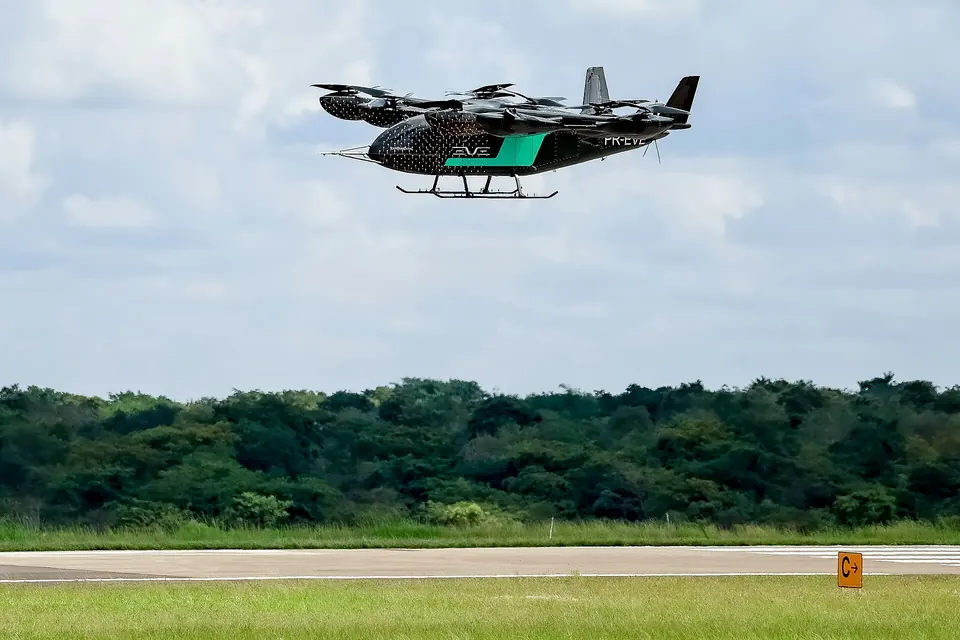
The photograph
The photograph is Eve's full-scale prototype at Embraer's Gavião Peixoto site in March 2026. It is not a picture of the November 5 call. Aviation Week credits Eve Air Mobility for the image on its November 5 story. This page uses the photograph already credited here.
What is not established
No type certificate has been issued. The $58.1 million loss, the $48.3 million of research and development, the $6.0 million of selling, general and administrative expense, the $55.1 million and $173.1 million cash-consumption figures, the $356.0 million cash balance and the $470.4 million liquidity figure are the release's. The full-year range is guidance, now expected at the low end. "Sufficient through 2028" is Eve's belief. Couto's "without new funding," his $471 million, his $114 million and his $50 million of captured savings are the call, as the transcript records them. Wingborne flight has not been reported as completed. Eight to ten flights and year-end are a target. The 73 flights, the 45 knots and the 170-of-185 test points are company figures from the transcript. The noise basis Basile said ANAC accepted is not a type certificate for the aircraft. The $60 million FlyBIS figure is a potential contract size on the call, not a price in the November 4 release. The 2,500-aircraft backlog is a pre-order book at list price, not a firm-order count. This page did not open the earnings slides. The rest of the Aviation Week article did not load. Dealroom's item on these results did not load.
Sources
- Eve Holding: Third Quarter 2026 Results (Nov 5 2026)
- Eve Holding Form 8-K, Exhibit 99.1 (Nov 5 2026)
- The Motley Fool: Eve Holding Q3 2026 earnings call transcript (Nov 6 2026)
- Aviation Week: Eve targets first wingborne transition by year-end (Nov 5 2026)
- Aviation Week: Johann Bordais interview (Oct 14 2026)
Facts as reported by the linked sources as of Nov 11, 2026. Company targets are plans, not guarantees. Corrections: see About.