
News · · 7 min read
Aridge's Deli Zhao tells the Guardian a $300,000 aircraft would be ready in the second half of 2027
The Guardian reported on November 10, 2026 that Deli Zhao said a $300,000 device, including the six-wheel van it unfolds from, would be ready for recreational users in rural places and for emergency services in the second half of 2027. The Guardian says China's civil aviation authorities have approved it for limited use. That sentence is not restated here as a named certificate. No type certificate is stated as issued. Público also reported his Web Summit remarks.
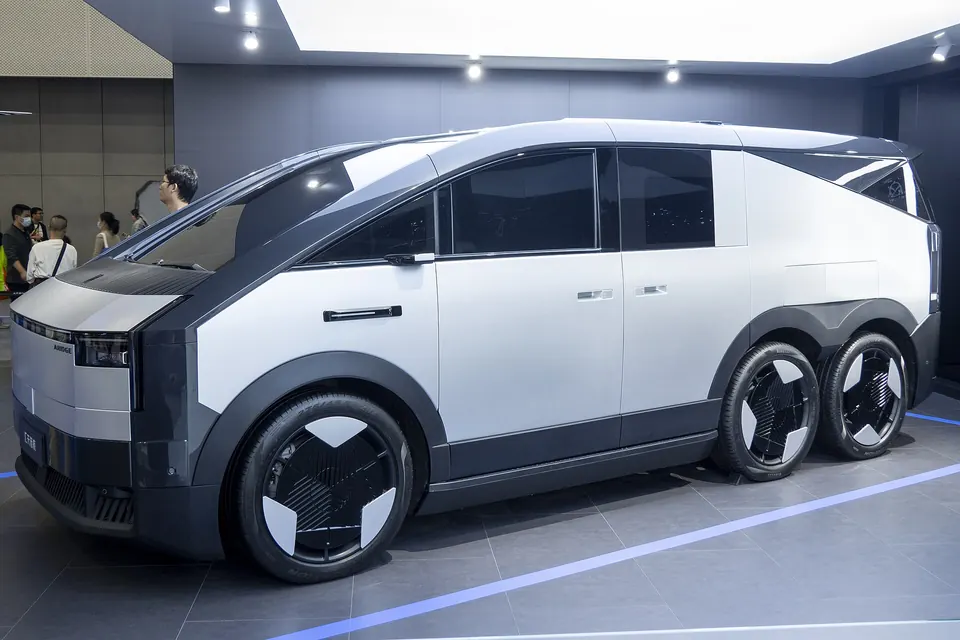
The Guardian reported on November 10, 2026, in an article by Robert Booth datelined Lisbon, that Deli Zhao said a $300,000 (£225,000) low-altitude device would be ready for recreational users in rural locations and for emergency services in the second half of 2027. The Guardian calls him the chief executive of the Chinese flying-car company XPeng. It says he spoke at the Web Summit in Lisbon on Tuesday, which the dateline makes November 10. The Guardian says the price includes a six-wheel van, about the size of a Ford Transit, out of which the flying vehicle unfolds. That price is the Guardian's report of what he said. It is not published here as an official list price.
This is a different speaker from the November 6 report. That article recorded sales manager Yang Jinbo saying small-batch deliveries could start as early as the second half of 2027. Zhao's "would be ready" for those two uses in the same half of 2027 sits in the same window. It does not move it. On October 20, chief financial officer Michael Du told Khaleej Times that consumer deliveries could begin in late 2027 and could slip into early 2028. Those remain targets. The Guardian article does not cite them, and it does not withdraw them.
What the Guardian calls an approval
The Guardian says that after 10 years of development, including trials of flying motorbikes at the company's Guangzhou base, the device "has been approved by China's civil aviation authorities for limited use." That sentence is the Guardian's. This page does not restate it as a type certificate, a permit, or any other named document. The Land Aircraft Carrier row still records a CAAC type-certificate application accepted in March 2024, a production-certificate application accepted in May 2025, and the chief financial officer's October 20 statement that the aircraft is at the TIA stage with the final type certificate pending. A TIA stage is not an issued type certificate. The Guardian does not use those names, and this page does not treat "limited use" as one of them.
The Guardian also says the vehicle will only be usable in approved park areas in China and by emergency services that need to reach inaccessible areas. That scope is the article's. It says the flight range is 30 km (18.6 miles), "although this will soon be doubled by increasing the battery's energy density to 400 kilowatts per kilogram." "Will soon" is not a date. The energy figure is printed as kilowatts per kilogram. This page does not convert the unit. It says the vehicle can cruise as high as 1 km, that six drone-like propellers lift a cockpit about the size of a Fiat 500, and that it can fly autonomously to a programmed destination. One sentence spells a name "Xhao" for the trained pilot it says claimed he could teach anyone to fly it in five minutes. The rest of the article names Deli Zhao. This page does not treat the two spellings as two people, and it does not correct the Guardian's spelling.
Zhao said, in the Guardian's account, that he had signed agreements with the United Arab Emirates and with countries in south-east Asia, and that "We aim to enter the European market as soon as possible." "Agreements" and "aim" are not firm orders, and the article does not name the documents. This page does not treat that sentence as the Ras Al Khaimah sandbox already on the company page. He said no one had yet been injured using the vehicle, that the initial target market was people interested in diving, surfing, off-roading and flying, and that his firm was one of about 20 in China working on flying vehicles. Those are his statements to the Guardian. The article says a prototype drew large crowds at the summit. It does not say a customer delivery has happened.
Público, the same summit, other sentences
Público reported the same day, in Portuguese, by Sérgio Magno, timestamped 10 November 2026, 16:45. The English here is this page's reading of that article, not a translation published by Público. Público calls Deli Zhao the founder and president of Aridge, the electric-aviation division of XPeng, formerly XPeng AeroHT. It says he gave this expectation, in reply to Público: "A minha expectativa é que, em 2028, as pessoas na Europa já possam experimentar voar nele." Read here, that is his expectation that in 2028 people in Europe would be able to try flying in it. He added that if all goes well he hopes for small-scale deliveries in Europe in 2028, or at least to have it flying there first. That 2028 line is his expectation. It is not the Guardian's second-half-of-2027 line, and it is not a European approval.
Público names the aircraft the Land Aircraft Carrier. It says Zhao quoted a five-minute claim: anyone learns to handle it in five minutes, and someone who does not want to pilot it presses a key for an autonomous flight between two points. It says he specified that flights stay below 1,000 metres. Michael Du, whom Público calls Aridge's chief financial officer, said at the press conference that flying the module requires a sport-pilot licence, which under the most demanding current rules means 30 hours of training, and that the company is in talks with regulators to shorten that time. A pilot licence is not a type certificate. Du said initial use is thought of for rural areas, natural parks, tourist areas with pre-approved corridors, and rescue in natural disasters or firefighting. He said airspace management over large cities is not yet mature. Those are his statements. They are not approvals.
Público says Du told the paper that small batches would go to partner flying fields in China by the end of 2026, with volume deliveries to customers left for 2027. "By the end of 2026" and "2027" are what Público reports him saying. They are targets. Partner flying fields are not described as ordinary customers. This page does not log them as a slip against the October 20 window, because Público does not cite that window and does not say it moved. Público says the reference price is around $300,000 (about €280,000), and that the global book is more than 7,000 pre-orders, mostly from private individuals. Pre-orders are not called firm. The earlier caveat on that count, on the August delivery note, stays in place. Público also says Aridge has a 120,000-square-metre factory in Guangzhou and has raised $1 billion from investors. It does not date the raise or name the investors, so this page does not add a funding row. Du said the plant would be ready in the next six months to start series production, and that full capacity would be up to 10,000 aircraft a year. "The next six months" is not a start date that has arrived.
Público says Du described a six-seat air taxi, the A868, for travel between cities, aimed at the market around 2030, with a stated maximum speed of 360 km/h and a range of 500 kilometres. No price, certificate or certification basis for the A868 is stated. It is not added as a tracker row.
The session listing
The Web Summit session page lists "Taking the flying car from sci-fi to reality" on November 10, 2026, 12.50PM–1.10PM, on Centre Stage. It does not print a timezone. It names Deli Zhao as founder and president of Xpeng Aridge, and it names the Land Aircraft Carrier. The listing's promotional lines, including "the world's only" and a factory figure, are the listing's. This page does not treat them as an independent report of the $300,000 remark. The Guardian's title for Zhao is chief executive of XPeng. Público and the session page say founder and president of Aridge. This page keeps each title with the page that uses it. The flying-car programme on this site remains Aridge.
The photograph
The photograph is the Land Aircraft Carrier's six-wheel ground vehicle at Auto Guangzhou in 2025. It is not a picture from the Web Summit. The Guardian's photograph is credited to AFP/Getty and is not used. Público's photograph is credited to Miguel A. Lopes / EPA and is not used.
What is not established
No type certificate is stated as issued. The Guardian's "approved for limited use" is not restated as a named certificate. No certification basis is stated in the November 10 articles. The second half of 2027, late 2027, early 2028, the end of 2026 for partner fields, and 2028 for Europe are targets or expectations. They are not deliveries that have happened. The $300,000 figure is a reported price. The Guardian ties it to the van. Público calls a similar figure a reference price and does not mention the van in that sentence. The November 6 report of RMB 2 million including one training place is a separate sentence. None of these is published here as an official list price. The 30 km range, the 1 km altitude and the energy-density line are the Guardian's. No firm order count is stated. The pre-orders are not firm. No European operating approval is stated.
Sources
Facts as reported by the linked sources as of Nov 23, 2026. Company targets are plans, not guarantees. Corrections: see About.