
News · · 10 min read
Ascendance rolls out the first full-scale Atea at Muret
Ascendance rolled out the first full-scale Atea hybrid-electric VTOL on November 19, 2026 at Muret, near Toulouse. AIN says ground testing has begun toward an EASA permit to fly for piloted flight testing. That permit is not described as issued, and a permit to fly is not a type certificate. First flight is a target. AeroTime says early 2027. The company page still says 2026. Letters of intent are not firm orders. No price is stated.
Aviation International News reported on November 20, 2026 that Ascendance rolled out the first full-scale example of its Atea hybrid-electric VTOL in Toulouse on November 19. AeroTime reported the unveiling the same day and places it at Muret-Lherm airfield, near Toulouse. A direct request for the France24 page returned 403. The AFP dispatch then loaded through a reader. Connaissance des Énergies carries an edited AFP copy, updated November 20, 2026, and a direct request for that page loaded. France24, that AFP copy and La Tribune are in French. English sentences from them on this page are translations. Ascendance's news index, opened November 20, does not list a rollout release. The Atea product page did load. The Ascendance and Atea rows record the rollout.
Where it was shown
AIN says the rollout was of the first full-scale example, at an unveiling at what it calls the Toulouse headquarters, and that ground testing of that aircraft has begun. AeroTime says the full-scale prototype was unveiled on November 19, 2026 at Muret-Lherm airfield, near Toulouse. AFP, in the France24 dispatch and the Connaissance des Énergies copy, says the prototype was presented on Thursday at the company seat in Muret, a suburb of Toulouse. La Tribune says it was presented on Thursday, November 19, from the hangar of the factory near Muret airfield, in Haute-Garonne. La Tribune says strong gusts meant a taxi sequence could not be run in front of the press. The other pages do not mention that taxi. A presentation is not a flight.
What the pages say the aircraft is
AIN calls Atea a four-to-six-passenger hybrid-electric VTOL, with eight vertical-lift rotors in the wing and a pair of propellers for horizontal flight. It says the aircraft is expected to have a range of 487 nautical miles and to cruise at 135 knots. "Expected" is AIN's word. It is not a flight-test result. AeroTime says eight electric rotors are embedded in the wings, and that two propellers, one in the nose and one at the rear of the vertical tail, are for forward flight. AeroTime says Atea is designed to carry one pilot and four passengers over a range of up to 400 kilometres, which it describes as a 350-kilometre usable range plus a 30-minute reserve. The product page, opened November 20, uses the same 400-kilometre figure, written as 350 kilometres of net range plus a 30-minute reserve, and the same one-plus-four count of operator and passengers. AFP says four to six seats and a maximum range of 900 kilometres, with two pairs of wings and eight rotors. La Tribune says the programme is to produce an aircraft able to carry four to six passengers over 400 kilometres. The pages do not reconcile the seat counts or the ranges. This page does not turn 487 nautical miles into 900 kilometres, and it does not treat 400 kilometres and 900 kilometres as one figure.
AeroTime says power comes from STERNA, Ascendance's hybrid-electric system: batteries for takeoff and landing, and fuel-powered generators in cruise, using Jet A-1 or sustainable aviation fuel, according to Ascendance. AIN says Sterna incorporates an onboard electric generator, battery storage and power management, and that this powertrain has already been subjected to more than 1,000 hours of bench testing. La Tribune says the presentation followed 1,000 hours of bench tests, more than ten prototypes and two wind-tunnel campaigns. AeroTime says that by February 2026 STERNA had accumulated more than 500 hours of bench testing over four years, which it attributes to Ascendance. The 500-hour figure is dated February. It is not substituted for the 1,000-hour figures. AFP quotes co-founder Clément Dinel, whom it calls responsible for propulsion and hybridisation, saying the propulsion has been fully validated on test benches and still has to be confirmed on the aircraft, with the aircraft's motion, wind, acceleration and vibration. Bench time is not a flight of the full-scale aircraft.
The product page calls Atea the first aircraft powered by the STERNA Hybrid Pack, and says several subscale prototypes have already been flown. "First" and "several" are the page's words. La Tribune quotes Jean-Christophe Lambert calling it a European first for a European aircraft designed from the start around hybrid-electric propulsion, and it calls Atea the first French hybrid VTOL. Those are claims on the page. This page does not adopt them as rankings. AIN says the founders came from the former Airbus E-fan programme. The other pages opened here do not say that.
The permit to fly, and when a first flight is a target
AIN says Ascendance said it has begun ground testing as part of efforts to secure an EASA permit to fly, so that piloted flight testing can begin. A permit to fly is not a type certificate. AIN does not say the permit has been issued, and it does not give a first-flight date. AFP quotes Lambert saying this phase does not mean the aircraft will fly tomorrow: four to five months of ground tests of all the systems, then low-speed taxiing, then a permit to fly that would allow high-speed taxiing, then a first flight. The quoted words, in the France24 text, end at the first flight. France24 then places that first flight toward the end of the first quarter of 2027. The Connaissance des Énergies copy does the same, in its own sentence: the timetable places the first flight toward the end of the first quarter of 2027. That quarter is the outlets' reading of the sequence. It is a target. AFP's quote does not name EASA. La Tribune says that after the rollout Ascendance can go on to four to five months of ground tests before obtaining an EASA permit to fly, hoped for next spring, in order to make a first flight. "Hoped for" is the article's word. Next spring is not a date, and the permit is not described as issued.
AeroTime says Ascendance expects the first flight at some point in early 2027, as soon as it gets permission from the aviation authority to start the flight-test campaign. AeroTime does not name the authority in that sentence. It also says that, as of the unveiling, the company website still listed a first crewed flight of the full-scale prototype in 2026, with certification targeted for 2029, and that no specific maiden-flight date had been announced. The product page, opened November 20, still says the company targets certification of ATEA in 2029 and subsequent entry into service, and that it targets the first manned flight of the life-size prototype in 2026, "currently under final assembly." Those are targets on the page. They are not the early-2027 and end-of-quarter targets in the rollout reports, and this page does not pick one. A 2029 certification target is not an issued type certificate. AeroTime also says that when the design was revealed in December 2021, Lambert said a full-scale prototype would enter testing in 2023. That sentence is AeroTime's account of an earlier statement. This page did not open a 2021 source.
AFP says the aircraft would then go through 18 to 24 months of flight tests before a possible industrialisation. La Tribune says the company intends to sequence the flight tests over two years, trying several configurations in stages. Those are plans. They are not a test programme that has started in the air.
Money, letters of intent, and Sterna for other aircraft
AIN says that since its launch in 2018 Ascendance has raised more than €60 million, which AIN writes as $66 million, and now employs over 100 people, and that it holds more than 140 patents. AeroTime says Ascendance has raised €60 million so far. AFP says eight years of development, €60 million of investment and 140 patents filed. La Tribune quotes the executive saying they reached this stage with only €60 million and 100 people. "More than €60 million" and "€60 million", and "over 100" and "100", are not the same sentence. This page does not merge them. The $66 million is AIN's figure. None of these pages presents a new funding round dated November 19. The sums are not a price for the aircraft.
AIN says potential customers have signed letters of intent covering more than 630 of the aircraft. AFP says more than 630 letters of intent to purchase have been formalised, according to Ascendance. La Tribune says that even before a first flight the aircraft has already taken 650 preorders representing a volume of more than €2 billion. Letters of intent are not firm orders. Preorders are not firm orders. The pages do not reconcile 630 and 650, and they do not state a unit price. The €2 billion is La Tribune's figure for that volume. It is not recorded here as a firm order book.
AIN says Sterna is also being offered for other aircraft, and that Ascendance intends to expand production of it in 2027 for its own programme and for prospective customers and partners. That year is an intention. AIN says the powertrain is also intended for fixed-wing aircraft and drones, such as Delair's DT46, which AIN says is being developed with backing from the French DGA defence procurement agency. AIN says that in 2025 Daher, Safran and Collins Aerospace joined forces with Ascendance on hybrid-electric propulsion for general aviation. "Joined forces" and "intended" are not firm orders. AeroTime says that on July 20, 2026, at Farnborough, Ascendance signed a letter of intent with ATR to explore hybrid-electric propulsion for future regional aircraft, and that on November 4, 2026, at Euronaval, it signed a memorandum of understanding with Naval Group on energy management and high-voltage architectures for autonomous naval platforms. A letter of intent and a memorandum of understanding are not firm orders. This page did not open the ATR or Naval Group releases. AFP says the propulsion system has led to partnerships with Airbus, ATR and Naval Group. It does not give the dates or the instruments. Those names are not an aircraft order for Atea.
AIN quotes Lambert, co-founder and chief executive: "When we founded Ascendance, we believed hybrid-electric propulsion could fundamentally transform aviation," and "Eight years later Atea demonstrates what that vision can become." The rest of the quotation says the ambition extends beyond one aircraft and that, with Sterna, the company wants hybrid-electric propulsion to become a new standard. "Want" is his word. It is not a standard that an authority has adopted.
The photograph
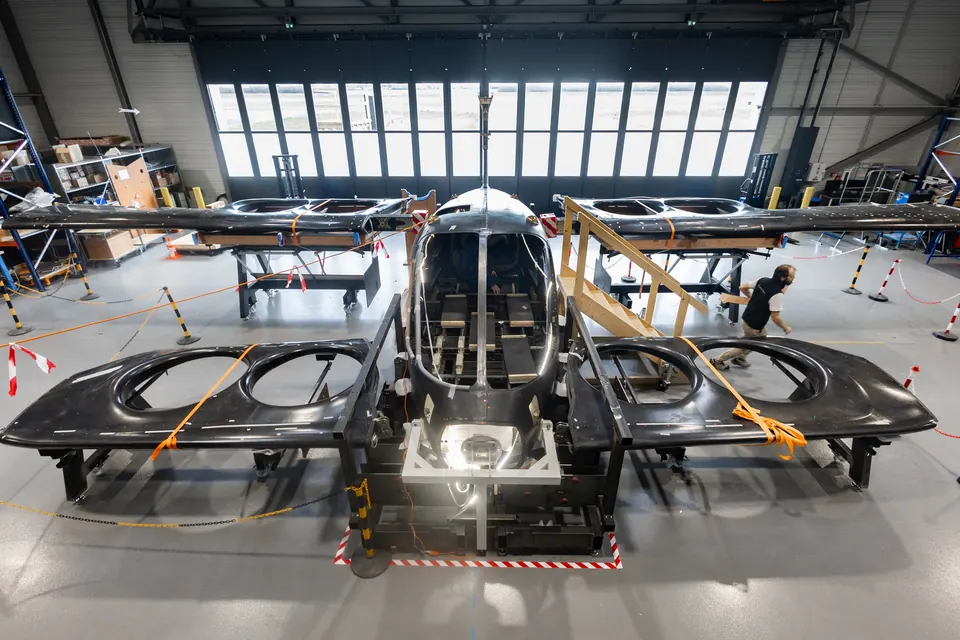
The photograph is from the media-center gallery on Ascendance's news page, file AQ5A4014. It shows a dark airframe indoors, with wing sections on stands and the fuselage open at the nose. The page does not print a caption, a date or a place. It is not a photograph of the aircraft outside at the November 19 unveiling. AIN and AeroTime published photographs of that unveiling. AeroTime credits its photograph to AeroTime. Those pictures are the outlets' and are not used here. The company news index does not include a November 19 release with its own photograph. No official video of the rollout was on the pages used.
What is not established
No type certificate is stated. An EASA permit to fly is a target in AIN and in La Tribune. AFP quotes a permit to fly and does not name EASA. No page says a permit has been issued. A permit to fly is not a type certificate. The full-scale aircraft is not described as having flown. First flight is a target, and the pages do not agree: the product page still says 2026 and "currently under final assembly"; AeroTime says early 2027; AFP's account places the end of the first quarter of 2027; La Tribune says a permit hoped for next spring, for a first flight. Certification in 2029 is the product page's target. It is not issued. Seat counts and ranges are not reconciled, and none is a measured flight. Bench hours are not a flight. Letters of intent and preorders are not firm orders, and 630, 650 and more than €2 billion are not one order book. No unit price is stated. The €60 million figures are not a new round. Sterna for other aircraft, the 2027 production intention, the Delair mention, and the ATR and Naval Group instruments are not orders for Atea. A company rollout release was not on the news index. The photograph is not the unveiling.
Sources
- Aviation International News: Ascendance rolls out Atea (Nov 20 2026)
- AeroTime: Ascendance unveils full-scale ATEA (Nov 19 2026)
- France24 / AFP: prototype presented at Muret (Nov 19 2026)
- Connaissance des Énergies, AFP dispatch (updated Nov 20 2026)
- La Tribune: Ascendance unveils Atea (Nov 20 2026)
- Ascendance: Atea product page
- Ascendance news index, opened Nov 20 2026
Facts as reported by the linked sources as of Nov 23, 2026. Company targets are plans, not guarantees. Corrections: see About.