
News · · 6 min read
NTU says its eVTOL demonstrators flew at Cochstedt
NTU Singapore said on a page published November 19, 2026 that two homegrown eVTOL technology demonstrators completed a flight-test campaign at DLR's centre in Cochstedt. NTU says it was a month long, in July 2026. The Straits Times, on August 25, said the tests spanned two and a half weeks and that the aircraft are not currently designed to carry passengers. No type certificate is stated.
Nanyang Technological University published a page on November 19, 2026 saying that an electric vertical-takeoff-and-landing aircraft designed, engineered and built by NTU completed a flight-test campaign in Germany. The page says that in July this year the nation's first homegrown electric aircraft took to the skies in Germany, and that the campaign was a month long, in Cochstedt. "First" and "made history" are the page's words. This page does not adopt them as a ranking. The Straits Times, by Esther Loi, published on August 25, 2026 and updated the same day, reported the same campaign as a first phase of flight tests. A FlightGlobal address for a related report returned 403 and is not used. These are technology demonstrators. They are not certified aircraft.
What NTU says happened in July
NTU says the team put two technology demonstrators through the campaign at the German Aerospace Center's National Experimental Test Center for Unmanned Aircraft Systems in Cochstedt. DLR, it says, provided flight-test expertise and the facilities. The larger aircraft, with an eight-metre wingspan, climbed above 90 metres. The smaller, three-metre prototype exceeded 120 kilometres an hour. NTU says the teams collected performance data while the aircraft hovered, transitioned to forward flight and flew on their fixed wings. Those heights and that speed are what the page states. They are not an independent measurement on this page.
NTU says the prototypes were remotely piloted by Professor James Wang, director of NTU's eVTOL Research and Innovation Centre, and by NTU alumnus Lu Weiyao, whom the page calls co-founder and technical director of Flare Dynamics Pte Ltd. It says Martin Laubner, a research scientist at the DLR Institute of Flight Systems, also took the flight controls. Remote piloting is not a pilot on board. NTU says DLR scientists studied the noise in hover and fly-over tests, and that the data will contribute to international research and yield insights into what is needed for future certification. "What is needed for future certification" is the page's phrase about the noise work. It is not a certification basis, and it is not a certificate.
NTU says the aircraft uses eight electrically powered lift rotors on the wings to take off and hover, and a rear propeller to push it forward. It says that as speed builds, the wings generate enough lift for the eight lift rotors to switch off. It calls that handover one of the design's biggest technical challenges. "Switch off" is the page's description of the design. It is not a separate test report with times or distances.
NTU says more than three years of engineering sit behind the flights, and that a team of about 30 research engineers designed the aircraft, developed new electric motors and integrated the systems. It says there was no open-air zone in Singapore large enough for the tests, so the team went to Germany, and that it met cold, shifting winds, limited windows, motor faults, system glitches and hard landings. It says each setback fed data back into the design, the flight controls and the procedures. It does not give a count of landings or of flights.
NTU quotes Wang: "This is a historic feat for an aircraft designed, engineered and built in Singapore. Reaching these heights, and going from hover to forward flight, marks a new milestone for Singapore-made electric aircraft." "Historic" is his word. The page says the team is now in discussions with investors and industry partners to scale the aircraft up and take it through further flight testing, toward industry adoption and potential uses such as cargo delivery. Discussions are not a funding round. Cargo delivery is named as a potential use. It is not a service, and it is not an order.
What The Straits Times reported in August
The Straits Times says the prototypes were tested for two and a half weeks in July, at Cochstedt. NTU's November page says the campaign was a month long. This page does not reconcile the two durations, and it does not treat one as a correction of the other.
The Straits Times says the eight-metre and three-metre aircraft are research technology demonstrators and are not currently designed to carry passengers, which it says the university said on August 25. It says that over those two and a half weeks the three-metre prototype gained close to two hours of flight over 17 flights, and the eight-metre prototype flew 43 minutes across 20 flights. It says the larger one reached 92 metres, and the smaller one reached 60 metres and a speed of around 120 kilometres an hour. It says the flight area was 1.2 kilometres by 2.4 kilometres. NTU's November page does not state a number of flights, a total time, a 92-metre figure, a 60-metre figure or the size of the area. Those details stay with The Straits Times.
The Straits Times says that at the end of the testing the eight-metre prototype had a hard landing and could not be repaired in time for the team to evaluate its forward propulsion, and that it was being shipped back to Singapore to arrive in October. "Will arrive here in October" is what the August 25 article says. NTU's November page says the demonstrators hovered, transitioned and flew on fixed wings, and it says hard landings in the plural. It does not say whether the eight-metre aircraft's forward propulsion was evaluated, and it does not say whether the aircraft had returned to Singapore. This page does not merge those accounts into one outcome.
The Straits Times says the team had not secured regulatory certifications from the Civil Aviation Authority of Singapore to operate the aircraft in Singapore, and that it had done some tethered tests at Kranji racecourse, with a rope securing the aircraft to the ground. The November page does not mention the Civil Aviation Authority of Singapore. No type certificate is stated on either page. The Straits Times also reports figures for government funding, a sum Wang said would be needed to start commercial operation, a possible 14-metre passenger variant, and a view that commercial use in Singapore could be around 2035. Those are in the August article. The November page does not state them, and they are not recorded here as a funding round or as a delivery date.
The photograph and the video
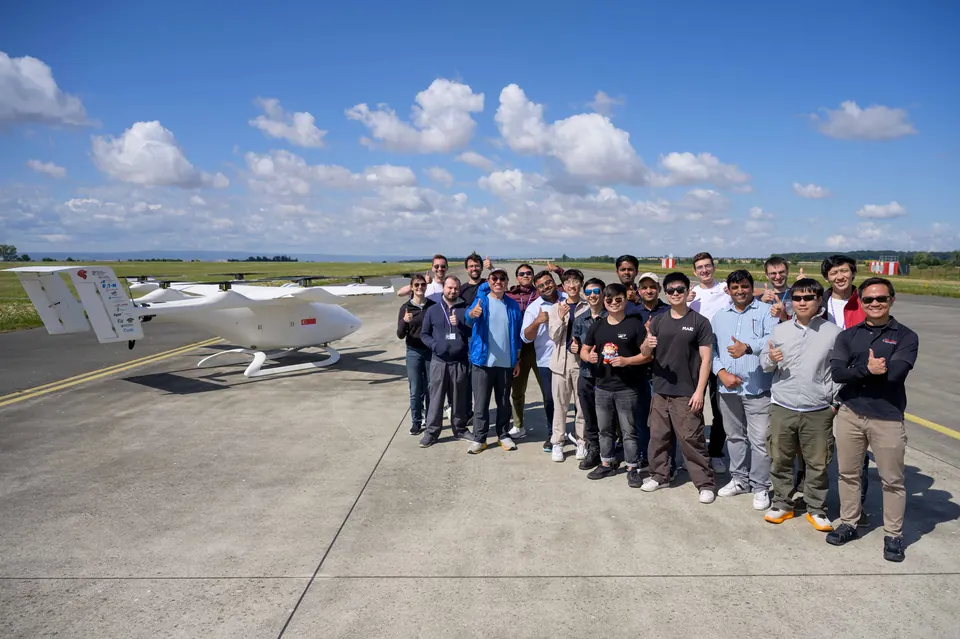
The photograph is the image on NTU's November 19 page. It shows a white aircraft with several rotors, on a runway, and a group of people. The page does not print a caption, a place or a date for the file. It is not labelled as a photograph of a flight. The Straits Times credits a photograph to NTU Singapore and other photographs to its own photographer. This page uses the file on the NTU page.
The same NTU page embeds a YouTube video. YouTube's page for that video gives the title "Singapore's first full-sized electric aircraft takes flight", the channel NTUsg, and a publish date of August 25, 2026. The November page does not say the video is a new flight in November. "First" in the title is the video's word.
What is not established
No type certificate is stated. The Straits Times says that, as of August 25, the university said the demonstrators are not currently designed to carry passengers, and that CAAS certifications to operate them in Singapore had not been secured. The November page does not say a certificate was issued after that. A noise note about what future certification would need is not a certification basis. The aircraft are technology demonstrators. They were remotely piloted, on NTU's account. The campaign length is not agreed: a month, on the November page, and two and a half weeks, in The Straits Times. Flight counts, minutes, 92 metres, 60 metres and the test-area size are The Straits Times' figures. The November page's "above 90 metres" and "exceeded 120 kilometres an hour" are the university's. The hard landing and the October return are The Straits Times' account of the eight-metre aircraft. The November page does not confirm them. No price is stated. Talks with investors are not a round. Cargo delivery is a potential use, not an order. No company release from a manufacturer, and no named product for sale, is on these pages.
Sources
Video
Singapore's first full-sized electric aircraft takes flight
Embedded on NTU's page published November 19, 2026. YouTube lists the publish date as August 25, 2026. The November page does not say the video is a new flight in November. 'First' is the video's title. Video and poster: NTUsg · Watch on YouTubeFacts as reported by the linked sources as of Nov 23, 2026. Company targets are plans, not guarantees. Corrections: see About.